Monday, October 31, 2016

Noche de Brujas

Noche de Brujas is what Halloween is called here in Peru. October 31st is primarily a religious holiday - All Souls Day. Trick or treating is starting to become more popular here as the population of ex-pats grows and the local children catch on to the idea of going door to door for candy. That said it is still not widespread as buying candy and giving it away plus purchasing children's costumes are luxuries simply beyond the means of many Peruvians. It makes the aisles of candy in the US big-box stores seem even more obscene. There is no Goodwill or Good Sammy or Salvation Army thrift store here where one can buy a second-hand costume. I asked our housekeeper if any children in her neighbourhood go trick or treating and she said no, because no one can afford the costumes. It's another reminder of how lucky we are to live the life that we do. We live the life that many can only dream of.
 
Marge and Maggie.
Halloween in Arequipa is also noted for being the day with the worst traffic of the entire year. That seems like a bold statement, given how bad the traffic is on any other day, but Halloween traffic is ridiculous. The first two years we were here, we were invited to Halloween parties held by other ex-pats on the other side of the city. Our usual 15-minute journey to get there took almost an hour each time. This year we're staying in and celebrating our 13th wedding anniversary - yep, on Halloween.  
 
This year I volunteered to host the annual Halloween party for our group of ex-pat children. We are very lucky that our house has a giant backyard that is perfect for outdoor parties. It was a lot of work to get everything prepared but it was a team effort and the result was a very fun party that was enjoyed by young and old alike. As you can see from the photo I went as Marge Simpson with Miss B as Maggie. N went as Batman and P channeled his inner Keith Richards and went as a pirate (in his pirate costume, large pirate hat and beer in hand, he looked like Keith Richards in The Pirates of the Caribbean). 

Friday, March 13, 2015

Catching Up

A year can go by so quickly (it's only 12 months, after all). One of my goals for this year is to be a more frequent blogger. We won't be here in Peru forever and it's important to record some things about this experience before it's over and I forget all the relevant details.
 
I don't want this to be just a travel blog, although travel is certainly something that we love to do. One of the perks of our assignment as ex-pats in Peru is a very generous travel allowance. I think that the secret to a successful ex-pat stay here is being able to get out of the country every now and then, to depressurize, to take a deep breath of somewhat cleaner air, to recharge the batteries and to remind ourselves why it is that we are doing what we are doing (and often, to question the wisdom of what we have decided to do).
 
A couple of months from now we'll have our second anniversary of living in Peru. Our son is in his third year of school here (because the Peruvian school year isn't the same as the US school year - here they start in March and finish in December). Having been in the same school for more than two years puts us in the league of "old-timers" who have seen many changes. In the ex-pat school, we now have our third school director in three years. With every year, people leave and new people arrive. When we arrived, the school had just a few teachers and only 12 students. Now there are more than 30 students and more than twice the teaching staff. The school is growing and we can see progress.
 
Our son speaks more Spanish now and is much more comfortable with the local language. Last year we went on a road trip to Cusco, the Sacred Valley and Machu Picchu, and there were several occasions when he was spoken to in English (because most strangers here assume that we are non-Spanish-speaking Americans), but he replied in Spanish. He both surprised and delighted us. It's really great that he is not afraid to use his developing language skills. Of course, if we ask him to say something in Spanish (usually for friends or family talking to us on Skype), he clams up and gets all embarrassed, then finds an excuse to go away.

This year our travel schedule has been turned on its head, mostly because of work commitments that will keep us here in Peru this Christmas (the last two Christmases we've been lucky enough to visit friends and family in our home country, which has been wonderful). We took a longer trip at Christmas this summer and went to both New Zealand and Australia. There really is no place like home. There was time to just relax plus time to spend with family and friends. We walked along the beach every morning (just not possible in Arequipa as the beach is 3 hours from here) and just soaked up as much of the experience as possible - the sights, smells and sounds, to sustain us while we are back here in Peru and far away from home.

We discovered last summer that there are very few ex-pat kids here in Arequipa over the summer holidays, because all the other families only have one parent employed outside the home, so the non-employed parent takes the kids back to Home Country X where they spend the summer holidays (almost 3 months) with their nears and dears. This summer there were actually a few kids here for a short time, but no more than just a couple of weeks between trips. With both parents working full-time outside the home, it's a very long summer break for N at home with our housekeeper and dog. So we try to break up the summer as much as possible with trips away, to alleviate the boredom and keep mischief at bay (at least we try).

So a few weeks after coming back from Australia, we headed off again for two more weeks of holiday (making full use of the travel allowance) in Florida and the Caribbean. It was absolutely amazing and really a fun holiday. It feels very indulgent to have had two completely wonderful and long holidays in such a short space of time, but there are no more holidays (other than a long weekend here and there) planned for this year. Our next holiday of a week or more won't be until at least January. This is where being an ex-pat is really going to get challenging, but it's also what we said we were willing to accept when we asked to have a month and a half away from work at the start of the year.

When others are flitting back and forth between Peru and established homes in the US, it's easy to become envious. We don't have an established home anywhere other than Arequipa. Now the strategizing of how long our stockpiled supplies of imported, locally unavailable products (such as my favourite shampoo, or fabric Bandaids, or a particular brand of tea) will last under the circumstances. Usually when we do go overseas I try to stock up on things that will see us through until our next trip somewhere. Right now, with no more holidays and no overseas work travel likely this year, the next trip somewhere is next year. We try to find local equivalents for things and sometimes those are good enough. Sometimes they look like the familiar products from overseas, even down to the packaging, but the contents and actual characteristics of the product leave us wanting. I'm very lucky that I have generous friends and work colleagues who are willing to bring a few extra things back in their suitcase (sometimes, the whole suitcase full, if I am really lucky!) of special items that really help to raise our spirits and help us feel more content with being here (sad to think that shampoo or crackers could make someone feel better about their life, but there you go). It's things that would otherwise be very easy to get and not a big deal if we lived in Australia or the US, like an engraved tag for the dog's collar, or an extra Wii remote. Stuff that often involves an afternoon-long fruitless search through one local department store after another as we try in vain to find something specific, to avoid having to ask yet another favour of a friend or coworker to bring it into the country for us.

So, where previous years' blog posts have been a lot about travel (I will get caught up on that and post some photos for you) and less about everyday life, this year's posts look set to be the opposite. I hope that you get some insight into the challenges, joys and experiences that make up life as an ex-pat in Peru.

Here's a fun fact for you: In my 41 years on Earth I have lived in 29 different houses, in 12 different towns or cities (some of them more than once) in four different countries on three different continents. I'm certain that I will be adding to this list before I'm done.


Sunday, May 25, 2014

Some thoughts on living in Peru

I just got back from a couple of weeks in the US. On the whole it was a great trip, especially as I was able to see and spend time with many friends from the six years that we lived in Arizona. I took N with me as he had a week of school holidays and on top of that, due to an immigration issue which delayed our departure from Peru by a day, he managed to miss a whole week of school. He had a great time playing and hanging out with several friends which was really good for him. As I've mentioned before it can be hard living here in Peru and this trip was a good opportunity to take N out of Peru for a little while so that he could have a break and have some fun for a couple of weeks.
 
Before departing on the trip we made our shopping list and wish list of places we wanted to go and things that we wanted to do while in Tucson. We were able to do most of them (we couldn't visit our favourite sushi place because it's on the university campus and the day before we visited, they had closed for the summer - we'll have to try again next time) and got our fix of McDonald's (doesn't take much to have had enough McDonald's to last me a long time) and Subway.
 
While we were in the US many people asked me how I like living in Peru. It's a question that I am asked a lot as an ex-pat, especially now that we are in Peru as it's a bit of an unusual place to live and lots of people are curious about it. I tell them that the work assignment is great and that we get to travel a lot (which we enjoy) but that Peru does have some challenges and that it's not the easiest assignment in the world. We don't have Walmart or Barnes and Noble or Trader Joe's, and we can't just go out and find everything that we need or want at the local stores that we do have. I share with them the restrictions of our security requirements and the social isolation that some of us ex-pats (especially those who are working here) experience. I tell them that it's not all bad and that there are some things that make living here very enjoyable (having a housekeeper who cooks our dinner; making friendships that we wouldn't have had the opportunity to make elsewhere) and rewarding (learning Spanish; experiencing a different culture first-hand; racking up valuable work experience). What I often forget to mention when asked about living here are the little miracles that remind me to cherish the time we have here and to try not to see it as something that has to be endured (which is how it can seem at times; how many more years?): a long-tailed hummingbird circumnavigating the garden; waking up to a clear blue sky and snow-capped mountains; the simplicity of people who live off the land and are perfectly happy with the little that they have. It can be easy to dwell on the negative things about living in a developing country such as Peru, especially when you are back in a familiar "first-world" country surrounded by lots of friends and all the modern conveniences that any "first-world" native could possibly want.  

Monday, March 24, 2014

Scouts: Siempre Listos!

We took a bit of a leap on Saturday when we went along to our first Scouts meeting here in Arequipa. N's school has a Scout group which is just starting its program for 2014 (the school year started this month). N was very apprehensive about going along because he wasn't sure if he would know anyone and of course there is always quite a bit of trepidation from him regarding activities etc in Spanish. His confidence is growing and he can understand more than he lets on, but still he felt that he needed P and I there for some reassurance and some handy translation.
 
The first session involved 2 hours of fun games for the kids. N's leader put him in a group with a couple of kids who could speak some English, to help him. N knew one other child from soccer and recognized one or two others from school. That helped to put him at ease. I acted as translator as best I could and between us (plus some explanatory hand signals and demonstrations from the leaders) we managed to get through all the games (even a couple of songs!) and had a good time.
 
Having been a Scout leader in the US I understand that groups like this need a lot of help from parent volunteers. There seemed to be a distinct lack of parents at this session (most of them appear to take advantage of the free babysitting and just drop the kids off) and I had already made up my mind before we went there to volunteer to help (so I did). I know it will challenge my Spanish skills (but that will be good for me) but it will help N too (when he doesn't understand what's going on, I can hopefully help him out) and really, I need it as much as he does. I've mentioned before that it can be challenging to work here in the particular situation that I am in. I am the only ex-pat wife who is also working a full-time job at the mine, so I am a demographic group of 1 member. I can't go to the lunches, trips to the market, coffee mornings, yoga classes, etc that the other ex-pat ladies do regularly, so I tend to miss out on that social interaction (but I do try to meet friends on the weekend so that I don't completely feel like a hermit or social outcast). Getting involved with Scouts (I hope) will be good for me and will help me to feel more connected with the local community. I don't yet feel attached to Arequipa in an emotional way so maybe this will help. Plus Scouts is just plain fun. And who doesn't like singing Spanish songs? 

Get off the road

Our normal way home from the mine was blocked today by "manifestantes", aka, protesters. About 400 of them had the road blocked so we had to take the alternate way home which adds about 30 minutes to the trip. One hour and 40 minutes after I left work, I arrived home. Anticipating then dealing with road closures (because of industrial action or protests) is one of the "features" of working here. We have contingency plans and the worst that normally happens is a small inconvenience and a son who takes the opportunity to eat pizza while his parents are out of the picture for an extra hour. The protests are usually non-violent and are more of a nuisance than anything. I feel sorry for the crews who had to work later because they had to wait for their relief shift which was late arriving. They will have a very long work day today. 

Sunday, January 19, 2014

Bienvenidos Bindi!

This bundle of fur is our new puppy Bindi, who became part of the Gelfi family this week. She is a 5 and a half week old golden retriever. We got her via the vet that several of our friends use. As you can see she is very cute and we are very grateful that as she gets used to us and her new home, she is also slowly becoming less nocturnal.
 
She is proving to be a very nice little dog but like all puppies there is a lot of work in looking after her right now while she is still very young (toilet training, don't chew the furniture and all that). Bindi is the first pet that we have had since we left Australia in 2007 and N was very surprised and excited when the bundle that I carried in from the pouring rain last Wednesday evening turned out to contain a little dog.

Summer holidays

It's the middle of the school summer holidays here right now and we are realizing one of the disadvantages of being two working ex-pat parents of a school-aged child. Every other ex-pat family here has one parent working at the mine and one parent at home who can be with the children. So what that non-working parent apparently does for the summer is leave Arequipa with the children and go back to their home town/state/country and spend the summer there, or they rent a house at the beach here in Peru (the coast is about 2 hours from Arequipa) and spend the summer there. Very few of them stay in Arequipa itself, which means that we have a boy who gets lonely and misses his friends, who he won't see again until March when school starts. We try to do things together when P and I aren't at work but it's certainly not the same for our son who just wishes that he had friends nearby who he could go and play with.
 
This is a problem that can have an effect during the school term as well because of the housing and security situation that is part of our life here. If N wants to visit a friend, unless they live in the same gated community (which they don't), it is quite awkward to go and visit them. There are friends who live in the gated community next to ours and although it would be just a 5-minute walk (it's really only a few hundred meters away), we aren't allowed to walk there. We have to arrange to go there with our security agent who then waits until it is time to take us home again. N can't do any of the summer vacation activities that are organized for kids (sports camps, drama and music classes, outdoor activities) because we aren't there to go with him and the agent has to be at the mine to drive us if we need it.

These are the times when we really wish that we had other family supporting us here.

Monday, December 16, 2013

Christmas letter 2013

Colca Canyon, May 2013
What an interesting year it’s been! Another busy one for the Arizona Arequipa Gelfis.

January: We enjoyed a wonderful couple of weeks in Australia, spending time with family and friends. Nathan played cricket for the first time and had a lot of fun.
 February: On our way back to Arizona we made a short visit to Arequipa in southern Peru to check out what is now our new home. There had been some very heavy rain just before we arrived which caused a lot of damage in the city. It was our first visit to South America as a family. Nathan turned 9! He celebrated with a small party with friends at home.

March: House-packing madness. Actually, most of March and April are a blur because there was so much going on. Paul made a trip to Bagdad (AZ) and Vancouver for work so was gone half the month.  

April: Paul travelled to Arequipa to start his new job (Concentrator Manager) and get our new home ready. He also got another year older and celebrated his birthday with dinner at a local Arequipa restaurant with friends from work. Meanwhile, I continued packing and finished my job at Sierrita in late April.

May: Nathan did a wonderful job in his end-of-year dance recital. He finished his year at Great Expectations Academy with great results. We left Arizona behind and officially made our big move to Peru.  After a couple of weeks of settling in, Nathan started school and I started my new job (Chief of Mine Technology and Systems). At the end of the month we visited Colca Canyon (one of the deepest canyons in the world) for a long weekend with friends.

June: Adjustment to our new life continues. After much searching and unsuccessful interviewing we were very lucky to find a wonderful housekeeper (Cleo) who helps to make our new life easier and more comfortable. She is a lovely lady who looks after us and we are very grateful to have her in our lives.
July: We attended a big 4th July party that was put on for the (mostly US) ex-pats in Arequipa. There was more celebrating when our moving boxes arrived from the US. Annette caught a nasty stomach bug that knocked her around for more than a week. It is just one of the things that are a constant threat living here. Although we take precautions we can still get sick sometimes. We visited Lake Titicaca and surrounding area in late July, coinciding with the Peruvian Independence Day holiday (actually, it’s two days). We visited the uros (floating man-made “islands” made of thick stacks of reeds) and Taquile Island, which was all very interesting and beautiful.

August: Learning Spanish continues. We have a lot of learning resources available and plenty of opportunity to practice. Gradually we are getting the hang of it.

September: Earthquakes are common here and we don’t usually worry too much about the small ones. In September we experienced our biggest earthquake so far: a 7.0. Being reasonably far away and fairly deep, there was fortunately no damage but it was definitely a very strange experience.

October: We realized a long-held wish and during Nathan’s school holidays we finally visited New York City. We spent a wonderful week there to celebrate both my birthday and our 10th wedding anniversary. On the way back to Peru I spent most of a week in Tucson for work. It was also a chance to stock up on a few “supplies” to take back to Peru.

November: Annette travelled to Santiago (Chile) for work and while there celebrated her 4-Uh-Oh birthday.  

December: School is wrapping up for the year and we will soon make our last trip for the year, to Tucson then to New Zealand for Christmas.

Plans for the New Year:


2014 is going to be a busy year for us. Work will get busier but we also have some fun travels planned. We wish for continued health, happiness and employment in 2014.


Best wishes for the New Year!
The Arequipa Gelfis (Paul, Annette and Nathan)

Thursday, December 5, 2013

Happy Miner's Day (we (move) rock(s)!)

P and I got a very special treat today: a day off work while N had to go to school. The occasion was El Dia de Mineria (Miner's Day), which is an official, government-sanctioned holiday for all people who work in mining. At last, a special day just for us!
 
We were invited to go for a walk with friends at Carmen Alta, in the Cayma district of Arequipa, not too far from home. Carmen Alta is an area near the river, where lots of different crops are grown and there is a nice road to walk on plus trails that lead down to the water's edge. When we go for walks here, what usually happens (especially when we go with friends; they have their security agent and we have ours with us) is that one car (with an agent) goes in front of us and one follows behind. We walk along and they keep pace with us, giving us enough space to feel comfortable but close enough that if we need them, they are there for us.
 
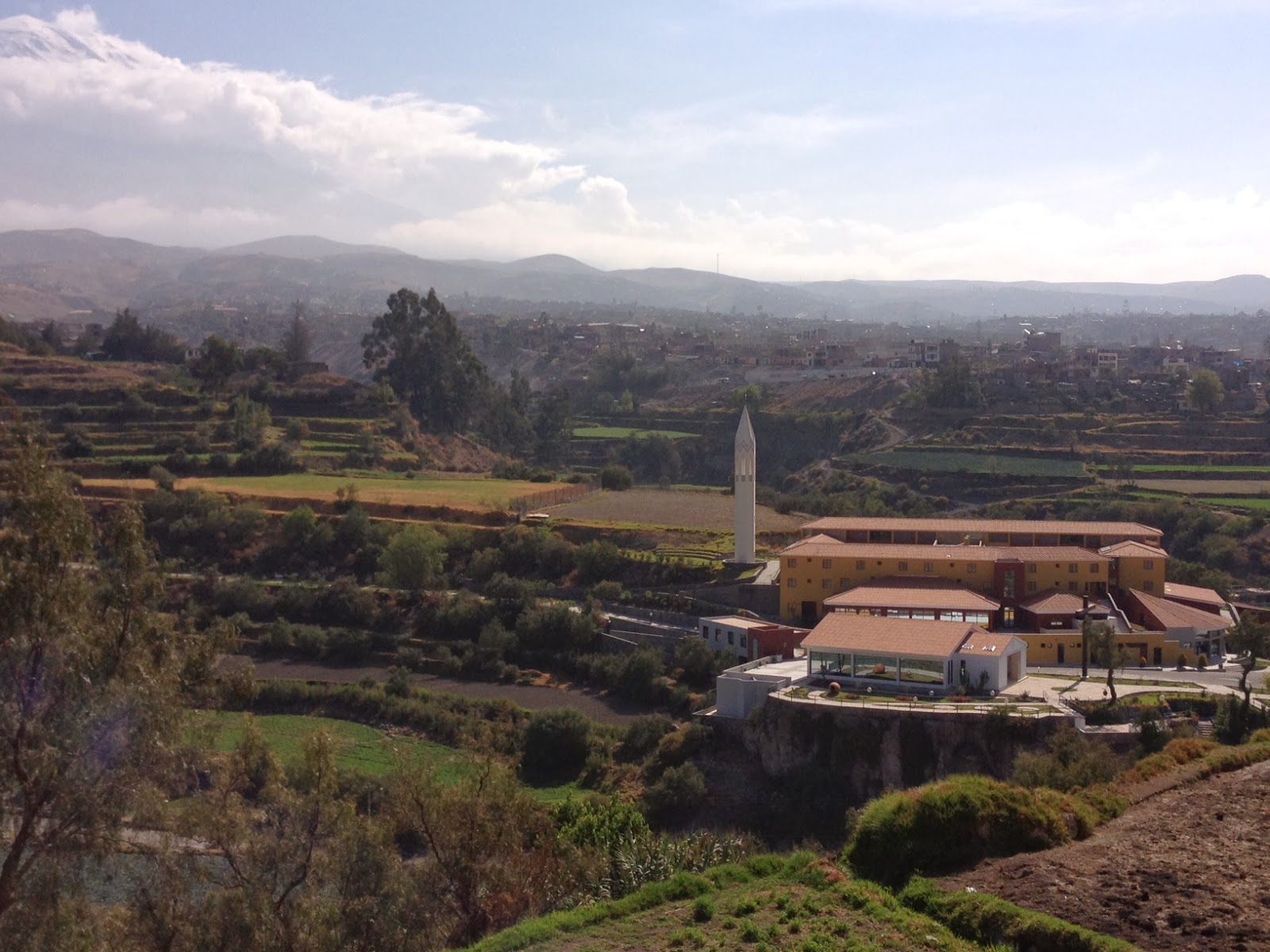
It was a beautiful day and great weather for walking. At Carmen Alta there are crops grown in the usual Peruvian way, which is using traditional agricultural methods. The fields are terraced and irrigation channels are built to direct water to the fields for periodic flood irrigation. Almost every available space is ploughed and planted. The soil is rich in volcanic minerals so with the plentiful water supply, the plants grow healthy and strong (but although this is traditional agriculture, there are some modern touches such as fertilizer and pesticide - these aren't organic gardens).
 

These farmers are using yoked bulls instead of a tractor to pull their plough.


These women are working their crops by hand, which is how most crops are cultivated here.

It's nice to go on walks like this and remember that there are such beautiful, peaceful places in the world where life seems to go at a slower pace and things seem much simpler than they sometimes do in more modern places. It's also a reminder that most of the world does not actually live in the same way that folks do in (for example) the US, Australia, New Zealand or Canada.

Unfortunately, dumping of rubbish like this is very common. It's so sad to see such a nice place being spoiled by folks dumping their garbage.

 
At the top of Carmen Alta is a mirador (lookout) from where you can get a really nice view of the whole valley.
The view from the Carmen Alta mirador.

This is El Ekeko, a character from traditional Peruvian folk tales. He carries a variety of items which are considered to be lucky charms.
 

Saturday, November 23, 2013

Up in Smoke

I was all set to make home-made bread today so I got everything ready, plugged in the bread machine and off it went. A couple of minutes later, it stopped. I had forgotten the critical step: plug the machine into the power converter to take it from 220V (Peru's voltage) to 110V (to safely run the bread maker). Unfortunately, even after leaving it to sit for several hours, it couldn't be revived and was declared dead at approximately 4.25pm. It was a silly, rookie mistake and I am just grateful that I didn't do it to my brand-new KitchenAid mixer (but there's still a chance...)!

Wednesday, September 25, 2013

Earthquake today

Just wanted to let any interested folks out there know that we are all safe and well here following today's earthquake. The rumble that I felt was like the vibration that you feel when a piece of heavy earthmoving equipment is approaching from some distance away. Both the sound and vibration grew stronger over about 20 - 30 seconds before the evacuation siren sounded and we had to leave our building. There was no damage to our building, home or N's school and we are all fine. After the building was cleared we all went back to work. Thank you to those of you who sent emails today expressing your concern. It is nice to know that you thought of us.
 
If you want to know more about the earthquake click here:
 
http://earthquake-report.com/2013/09/25/very-strong-earthquake-acari-peru-on-september-25-2013/

This site mentions that three miners were killed by the earthquake. These workers were not at our mine and at the time of writing, those deaths are not confirmed.

Sunday, September 1, 2013

Misti and Chachani are active today

We are very lucky that from where we live we can see the three big (>19,000 feet) volcanoes that overlook Arequipa. Today we noticed that Misti and Chachani are puffing out smoke, indicating an increase in activity (once a geologist, always a geologist). Here are a couple of photos of Misti this morning:


We have our "Go Bags" (which we keep ready in case of evacuation due to earthquakes (frequent here) or volcanic eruptions (less common but still obviously a possibility)) just in case we need to. Let's hope not!

Lo Que El...? (What the...?) #2

Here's another quirky thing about living in Peru. This sign was on the door of a toilet cubicle in Lima airport:


Unfortunately it's a bit blurry, but it says: "Le agradecemos no arrojar papeles ni toallas higienicas en el inodoro" which translates as "Please don't put toilet paper or sanitary towels in the toilet." That's right folks, no toilet paper in the toilet please (there are rubbish bins inside every toilet cubicle for the used paper to go in, so you can imagine that they don't always smell too good). Evidently, sewerage systems in Peru are not designed to accommodate toilet paper, which is designed to be put into... sewerage systems.

Thursday, August 29, 2013

Lo Que El...? (What the...?) #1

I thought I'd add this occasional section because it's a fair statement that we see some pretty strange things here from time to time. A week or so ago I saw a tiko (one of the many little taxis that operate all over the city in Arequipa) with a huge tree tied onto the top of it (I wish I'd been able to get a photo of it but sometimes these things go by so quickly that there isn't time to get the camera out and grab a photo). The tree was about as big as the tiko and extended well over the windshield of the car. I made a comment to our agent about it and he told me about the time when he was with another ex-pat a few years ago, and they saw a tiko with a cow inside. Yes, folks, an actual cow, sitting in the back of the taxi. And no, it wasn't wearing a seatbelt.

Thursday, August 15, 2013

You don't look a day over 473

One of the wonderful things about life in Peru is that there are a lot of holidays. It seems that every month there is at least one government-sanctioned reason to take the day off work and school. In August, the major holiday in our part of the world is El Dia de Arequipa (August 15), commemorating Arequipa's anniversary. Like many holidays in Peru, the celebrations for El Dia de Arequipa start the day before. The day before El Dia de Arequipa the city was as packed with people and traffic as I've seen it yet. I had to go to the ATM at a local shopping center and instead of the journey from work to the mall taking about an hour (as usual), this time it took a full hour and a half, just because of all the additional vehicles and people who had come to Arequipa and were out and about in the city for the festivities. There was a famous Peruvian band playing in the city that night so that would have drawn more people to the city too.

 
Coming from a relatively young country like New Zealand, it's amazing to me that a city can be as old as 473 years, but that was the number of candles on Arequipa's cake this year. In the "modern-traditional" way that is the custom, Arequipa Day (and any other day to be celebrated: birthdays, baptisms, job promotions, Tuesdays, etc.) are punctuated with copious amounts of fireworks and partying. On holidays, these parties and fireworks last all through the weekend. I've been awakened by fireworks at 6am, and heard them at midday and in mid-afternoon. The lack of available darkness with which to see them at their best effect doesn't seem to be a reason to not set them off.
 
In addition to these everyday festivities, our city's special day is also celebrated with a huge procession that winds its way through the city. This parade stretches for about 4km and includes dancers and performers from all the regions around Arequipa. It starts at about 6pm and wraps up at 11pm. I wish I had photos to include in this post, but since we haven't been in Arequipa long and I was a bit worried about security with so many people out to watch the parade (and since our security people were on a higher alert than normal, and warned us to take extra precautions for our safety) I elected to give the parade a miss and we spent the day at home relaxing and listening to the fireworks instead. Certainly we missed a wonderful, amazing spectacle. Next year we'll try to go and hopefully then I can share some pictures with you.


Sunday, June 30, 2013

Small fish, big sea

About a month ago I started my new job. I am in my 14th year working in mining and really enjoy what I do. I have a great job and the opportunity to live and work in a country as fascinating and challenging as Peru is the experience of a lifetime. Of course, it's not just a matter of packing up one office, moving into a new one and hitting the ground running (although it would be great if it was).
 
We are the first ex-pat married couple to be working at our company's mining operation here in Peru. Usually just the husbands go to work at the mine and the wives stay home, either with the kids or on their own, to spend their days however they will. As far as Peruvian culture goes, the wives almost always stay at home to care for their children until they leave home (if they leave; it's not uncommon for multiple generations of a family to all live together in the same house). If they have young children, it is very rare for mothers to work, and certainly not full-time, and certainly not in mining. So what I am doing is not normal. Here's an example: recently I interviewed a number of different women to work in our home to help us with cleaning, cooking and looking after our son while we work (yes, a maid). There was always an interpreter at the interviews, as my Spanish isn't fluent yet and none of the women whom I interviewed spoke any English. When I explained to each of these women that I needed a maid full-time (as in all day, every week day) because I work full-time as a mine engineer, they all expressed the same look of total amazement, that a woman with a young child would contemplate such a thing. At one interview, the woman who was coordinating the interview on behalf of the maid agency was completely shocked to know that I was working at a mine. She had never met an ex-pat wife who worked before.
 
The people whom I work with are really friendly and seem to go out of their way to make me feel welcome. I look forward to going to work and being with them. At the same time, there are some times when I feel a bit alienated and wish that I was just a little bit less "different". I don't dress the same as most of the other women who work at the mine (most of whom work in administrative roles and tend to wear more "fashionable" clothes than the standard mining wear which is jeans/long pants and a polo/button-down shirt, which is what I wear to work), so I look different. Obviously I'm not a man, so I am clearly different in that regard than most of my work colleagues (there are two other female engineers in my department, so I'm certainly not the only one). And I am definitely different than all the other ex-pat wives, as I am at work when they are in town, catching up over coffee or visiting the market together. I'm grateful that they include me in their invitations to do these things, but it can be hard having to say "Thanks for inviting me but I'm working that day" over and over again.

I am grateful to have this job and as I said I really enjoy the work that I'm doing. I'm blessed to have stayed employed for this long and to have been given this opportunity. I guess my point is that it doesn't come without some sacrifices and challenges. One of the challenges is to embrace being "different" and to see it as a strength instead of something to regret.


Saturday, June 8, 2013

Colca Canyon

A couple of weekends ago we were invited to spend a long weekend with friends (and their son, who was visiting from the US) at Colca Canyon, which at approximately 10,000 feet deep is one of the deepest canyons in the world. Colca Canyon is a 3-hour drive from Arequipa.
The road to Colca from Arequipa starts out very narrow and winding, skirting around the base of the Chachani volcano, with sheer drops, little or no barrier in most places, and too many roadside memorial crosses to count. Double yellow lines? If it's clear, pass anyway. Truck coming the other way? Put your foot down, you can make it. Bus coming toward you in your lane? Say your prayers and trust your driver. What choice do you have? In one particular place along the road there are 24 crosses in two groups, where a bus went over the edge just before Easter this year, killing most of the people on board. A similar accident two weeks earlier killed 14 people. Sadly this sort of thing is not uncommon here. So this particular part of the trip was a bit anxious (for me at least) but thankfully we made it through without incident.
 
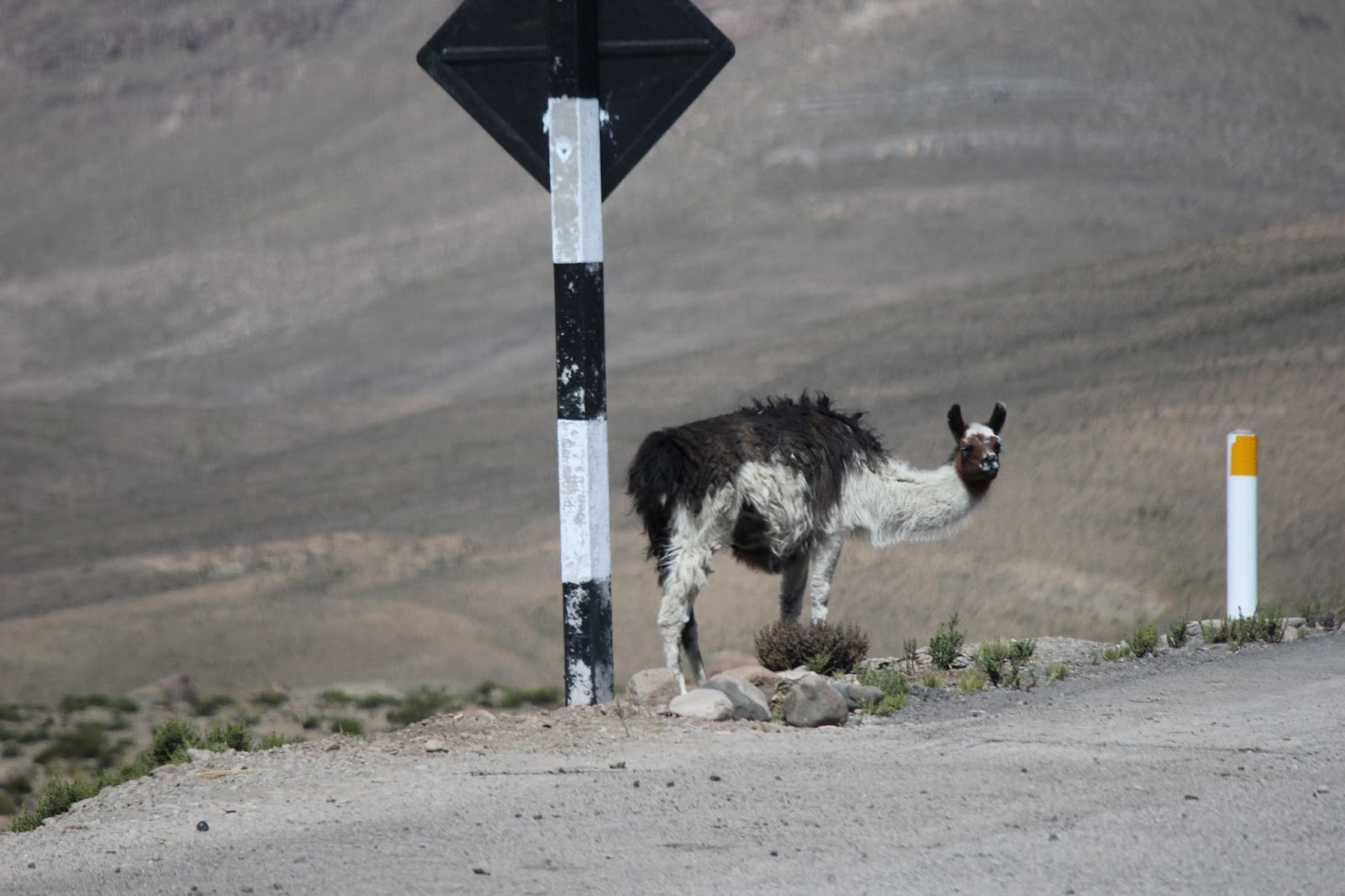
Leaving the windy, narrow part behind we entered the Reserva Nacional Salinas y Aguada Blanca where the road is straighter and the vicuna (Peru's national animal) and llamas are plentiful. Vicuna seem slimmer than llamas and are coloured a lot like deer, with white underbellies and a warm light brown coat on their backs and necks. Llamas are much shaggier and come in a wider variety of colours. They are stockier than vicuna and tend to roam in larger herds. Vicuna are wild and produce an incredibly fine wool which is highly prized for woven garments. Vicunas only produce about 1 pound of wool each year so they are only shorn once every 3 years. There are special chacus (kind of like a vicuna round-up) where the animals are caught, shorn then released into the wild again. Because the fiber is so fine and there is so little of it available for spinning and weaving, items made from vicuna wool are extremely expensive. For example, a scarf made from vicuna wool costs about US$700. It was great to see so many of these special animals which we had read about, ranging around in their natural habitat. Vicuna in particular are pretty timid and tend to run away when startled, so I'm grateful that I had a zoom lens on my camera and was able to get some pictures of them.


Llamas grazing.
Vicunas crossing.
Llama
 
Gelfis at Mirador de los Andes.
We stopped at Mirador de los Andes, the highest part of our journey, at 4,910 metres (16,108 feet) to get some photos (Runtastic says it's only 4,873m but I prefer to believe the hand-painted sign). From here you get a fantastic panoramic view of the volcanoes Misti, Chachani, Sabancaya and Ampato (the first three are more than 19,000 feet high; Ampato is over 20,000 feet). At the time we arrived, the women selling souvenirs (woven blankets, embroidered items and the ubiquitous chullo hats (knitted hats with ear flaps that are sold almost everywhere in Peru). I found it a bit harder to breathe at the Mirador - probably a combination of the altitude (the highest I've ever walked at) and the throat infection that I was still trying to shake off.

The closer we got to Colca Canyon, the worse the road got. Colca is about 150km from Arequipa, but the condition of the road is the reason why it takes 3 hours to get there. Rather than the road having lots of pot holes in it, the pot holes have little bits of road around them on which we were supposed to drive. Avoiding the holes frequently means driving on the wrong side of the road, so the driver has to have one eye on the pot hole and one eye scanning ahead for oncoming traffic. We were grateful to be travelling the road in daylight (we had originally planned to leave after N got home from school, which would have meant driving the last hour to Colca in the dark, but as it happened N's school start date was delayed so we were able to leave earlier in the day) because at night it would have been treacherous - no road markers, no barriers, plenty of cliffs, lots of ways to have an accident. 

Eventually we arrived at Chivay, the village where we would stay while visiting Colca. It is a very quaint, traditional rural village where agriculture and tourism are the main sources of income. We saw children herding sheep (and getting very excited about having their picture taken), traditional buildings and lots of fields of crops (corn, kiwicha and other local grains). We stayed at the very comfortable and scenic Las Casitas del Colca (basically a resort). The Casitas are close to the river that runs through the canyon and the scenery is fantastic. I did a cooking class and learned to make lomo saltado (one of the most famous dishes in Peru, it is a lot like Mexican fajitas: strips of beef (or alpaca) seared in a pan with slices of onion and red pepper, but rather than being served in a tortilla, as fajitas are, lomo saltado is served with rice or in this case, quinotto (quinua risotto)) and we watched a demonstration of how to make pisco sour, Peru's national drink, which is made from pisco, lemon juice, egg whites, sugar syrup and Angostura bitters - really strong but very good. N and P fished for trout and managed to catch three - very exciting for N as it was the first time that he had caught a fish (and to catch more than his father did made it even more exciting).

Look carefully: 8 Andean condors.


On Saturday morning we drove for about 30 minutes along the canyon to a viewpoint where we were told we could see Andean condors. Our luck was in because at a smaller lookout point, before arriving at the main lookout we were lucky enough to see 10 condors at once. The condors can only be seen from the lookout areas for a couple of hours in the morning (about 0700 - 0900) before they head out into the far reaches of the canyon for their day of hunting for food (why they don't just get up and go out looking for food, I don't know. Maybe they need to stretch their wings and get warmed up first).

Further up the road, at the Mirador de los Condors there were more people but fewer condors. We waited about 25 minutes and were about to give up and leave when the first couple of condors appeared. To watch these huge birds soaring over our heads and down into the canyon was truly amazing. Adult Andean condors have a wingspan up to 3 metres across. Compared to the previous viewpoint we saw fewer condors but we were able to get a much closer look at them. One condor landed right in front of the mirador and stayed there for a long time while the tourists (me included) got their pictures. It was almost as though it knew what it was supposed to do to entertain the crowd.

At all the more popular tourist stops (such as the Mirador de los Condors) and at many of the smaller ones, there are local women selling snacks and handcrafts. We passed a lot of their little booths on the side of the road as we travelled through the canyon. At Mirador de los Condors I bought a jacket for N made of baby alpaca wool and an embroidered pillow cover with a vicuna and a condor on it. One of our friends bought a traditional Quechua hat, like the one that the woman in this photo is wearing (my friend collects traditional Peruvian hats). These sort of souvenirs don't cost much, sometimes aren't actually made in Peru, and help the local economy.


Quechua woman in traditional clothing at the Mirador de los Condors.

After leaving the Mirador we drove further up the canyon, through some more small villages where we stopped to take photos. One such village that we stopped at was Cabanaconde, where I surreptitiously took some photos of local people, because their dress and manner fascinated me.

Like most villages in the Colca area, although the village is tiny, it has a huge Catholic church at its centre.


Restoration work, rural Peruvian-style. Using people power and a basic pulley system to haul buckets of materials up to the top of the building.


Women in traditional Quechua dress, Cabanaconde.


Further along we crossed the canyon and made our way back toward Chivay on the other side. There was so much beautiful scenery to see and so many photos to take. It's such pretty country. There were very few cars and the whole area is pretty much untouched by tourist development. Apart from the Casitas the only other resort in the area is the Colca Lodge, which is on the opposite of the river to Chivay. We ate an absolutely delicious lunch there and took a short walk around the grounds before we headed back to Las Casitas.


One thing about staying at Las Casitas is that it is situated on the side of a steep hill (almost everything at Colca Canyon is on the side of a steep hill). I mentioned before that it was harder to breathe at the Mirador de los Andes, well, Chivay is at 3,635m (11,925 feet) so there is some altitude to deal with there as well. I found that walking on flat ground or downhill was OK but the moment that I had to walk uphill I suddenly felt as though I had aged 50 years. I had to walk really slowly and take rests every now and then. Maybe in time I will adjust to the altitude but it was pretty amazing how much it affected me.

Look! I'm actually in one of these pictures!

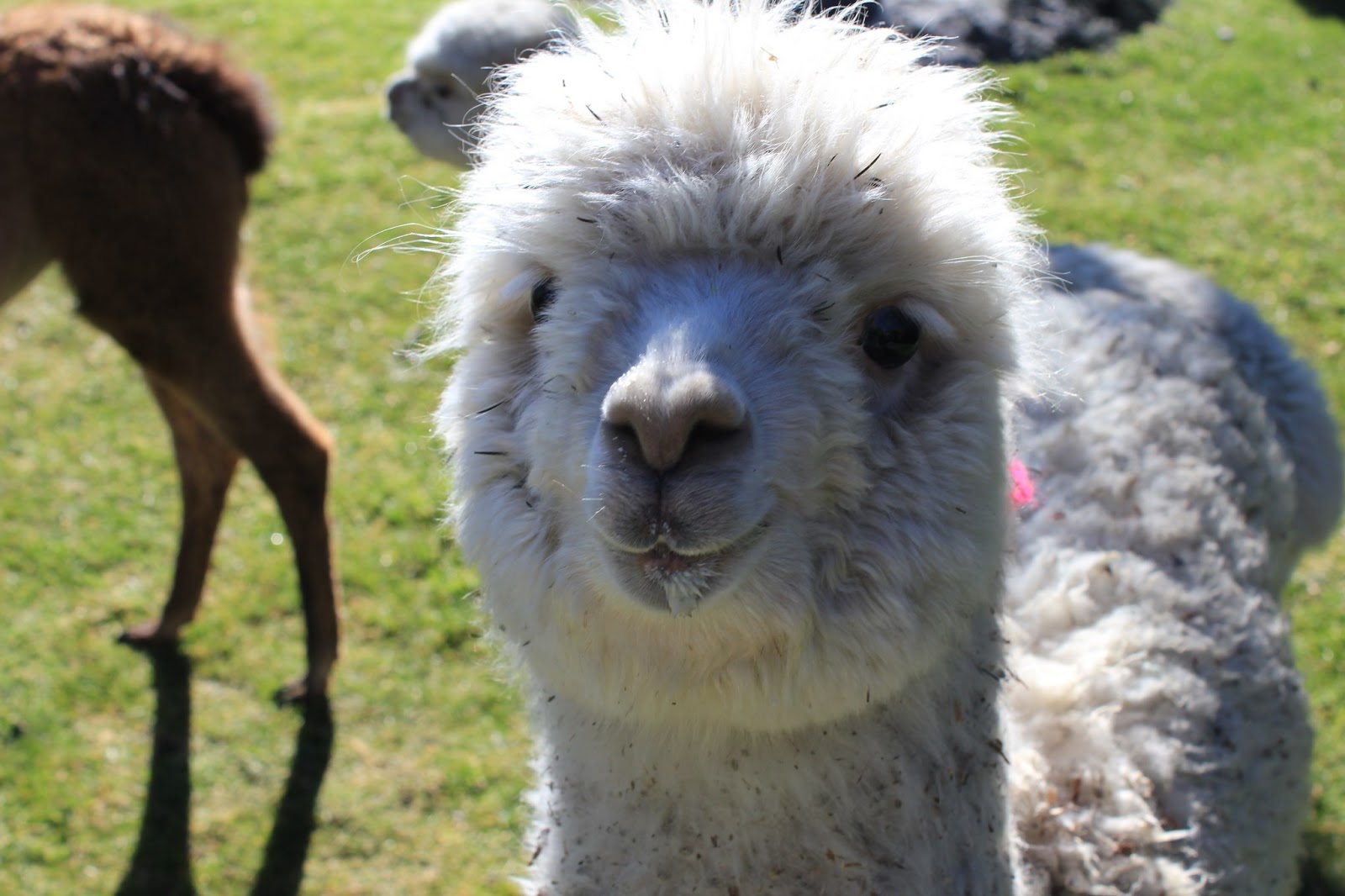
On Sunday before we left for Arequipa we arranged for N to feed the baby

This is just plain adorable.

alpacas and llamas at the Casitas. All three of us were given bottles to give the babies who were very hungry (or greedy) and didn't take long at all to finish the lot. The alpacas and llamas were so soft and cuddly, and very huggable! Once they'd been fed they didn't hang around long and headed back to their enclosure.


Our drive back to Arequipa was thankfully safe and uneventful. It was a wonderful weekend that felt a bit like being in an episode from the Travel Channel. I am sure that when we get visitors (I hope that we do) we will be taking them to see Colca Canyon and sharing all these amazing experiences with them. We are very lucky to have a place like this just a few hours away from our home.


Thursday, May 23, 2013

Doctor

Yesterday I didn't feel very well at all. The sore throat that I developed the day before had kept me awake at night and during the day yesterday I could hardly talk because to do so made my throat hurt so much. It felt like I was trying unsuccessfully to swallow broken glass. P was able to make arrangements via his assistant at work for me to see a doctor at the local clinic so when P got home from work, our agent drove me to the doctor. By then, as well as the sore throat and croaky voice, I also had chills and felt really weak, like death warmed up.
 
The clinic was near the hospital in Yanahuara, a suburb of Arequipa and about 15 minutes from home. Our agent assured me that the doctor I would see could speak English, and said that she was also a translator, which was a big relief for me. I didn't have a phrasebook or dictionary with me and didn't like my chances of being able to explain how I felt if I had to do it all in Spanish.
 
I saw a very nice doctor from Quebec who asked me if it was OK if a nurse and the local doctor also took part in my examination, as they were learning how to treat patients using medical methods from the "modern" world (I wonder what they had been doing before). Of course I didn't mind. The examination room was very basic, with just a bed to sit on, a blood pressure monitor and a big jar of tongue depressors. The nurse took my temperature by putting the thermometer in my armpit then took it again by mouth (after washing it!) - I had to wait 5 minutes with the thermometer in my mouth before the nurse confirmed that I did have a fever. The doctor decided that I had a throat infection and prescribed some antibiotics. She told me that I could either wait at the clinic for someone to go and get the medicine for me or I could go with my driver to get it then go straight home - I decided to do the latter. There was no fee for seeing the doctor and they didn't ask for insurance.
 
Apparently there were two pharmacies that could fill the prescription but our driver took me to the one where you don't have to pay. It had a tiny little store front where apart from medicines you can also buy tissues, toothpaste and lots of different toys. Helping the pharmacist behind the counter was a boy in a school uniform. The agent gave the pharmacist the prescription and a few minutes later I was given a plastic bag with the antibiotics (no label with my name on it or directions for taking it, just the box of tablets - luckily the doctor had told me when to take them and how many) and some throat lozenges. Then the pharmacist said something to the agent which I didn't understand. Then the boy from behind the counter came out with a bag and the agent told me that the boy was coming with us. I wasn't sure what was happening but when the agents tell us to do something we trust them and go with the flow. We got into the car and drove to another hospital where we parked and waited a few minutes while the boy went inside and came out with a thermometer for me. He waved goodbye and we drove home (I presume that he made his way back to the pharmacy somehow).


Wednesday, May 22, 2013

No Habla

Yesterday was one of the most challenging days that I have had in Peru so far, because of the problems that I had with communicating in Spanish. I'm trying hard to learn as quickly as I can, by practicing my Spanish as much as possible. There are times when I feel confident, capable and able to make myself understand. When that happens I feel really good, like I can make this experience work and be able to handle whatever comes my way. Yesterday was not one of those times. Here's what happened:

Situation #1: Pest controller (exterminador)

When someone comes to the house, either to visit us or to do work (eg. maintenance, which is happening daily at the moment) the vigilante at the gate calls us on a special phone which rings just once to tell us that we have a visitor. I pick up the phone, say "Hola" then listen for any recognizable words that might give me a clue about what is going on. I didn't really understand much of what the vigilante told me except that obviously someone was at the house to do something, so I said, "Si, bueno" so that they would be allowed to come in.

It turned out that the visitor was a man who had come to place rat poison in the garden. The gardener told us that there were a lot of rats on our property because it backs onto an agricultural area where local people grow onions. Evidently the rats require continual poisoning campaigns because when one group dies, more come and so it goes on. Anyway, the man arrived carrying a bag of pellets and rattled off a lot of words in Spanish that I did not understand. I told him (in Spanish) that I didn't understand and asked him to please repeat, which did not benefit me in any way as I was still totally confused about what he wanted. I went inside and got our Latin American phrasebook which had nothing at all that I could use with which to communicate to this poor man who by now probably thought that he was dealing with some unfortunate house-bound gringa who couldn't even speak basic Spanish. By using gestures, his two words of English (rats and poison), he indicated that he wanted to put rat poison around the garden, but not inside the house, and I told him (lots of nodding, "Si, bueno" etc) that this would be OK. So he left and didn't come back. I was very confused because I thought that we had agreed on what he was going to do, but obviously I hadn't understood as much as I thought I had.

Situation #2: Interviewing housekeepers (amas de llaves)

We will need someone to be with N for an hour in the morning after we leave for work while N waits for the school bus to come, and also to be with him in the afternoon for a couple of hours while he waits for us to come home. Since we are both working (and it's an expectation that ex-pats will employ home helpers), we might as well employ someone who can look after N as well as help us keep the house clean. Through friends we were able to arrange for two women to come to the house yesterday to be interviewed as potential housekeepers. I was very nervous about interviewing housekeepers and didn't sleep too well the night before. I've never had a housekeeper before. I've been in Peru for a week and I didn't really know how this sort of interview was supposed to go. I didn't know what the applicants' expectations would be and what the normal protocol was, and I worried a lot about saying or doing something wrong that would upset or offend the person whom I was interviewing. I didn't want to be an ignorant gringa. I also knew that a lot depends on us getting someone reliable and trustworthy to look after our son and help us to successfully manage being working parents in Peru (it's not normal for both the husband and wife to be working here, so most ex-pats don't need someone to look after their children for the hours that we do, as most of the ex-pat wives are at home for their kids. Most ex-pats just hire someone to come and clean the house, perhaps cook for them, and occasionally babysit the kids when the parents need to go out). So I put a lot of pressure on myself for everything to go well.

A friend volunteered to be my translator for the interviews and she also arranged for Louisa, the official Freeport Spanish teacher and translator to help me out. So I thought that with these ladies with me, everything would go reasonably smoothly and that I would be able to get through the interviews without too many problems. I'd be able to communicate what I wanted to say and I'd be able to understand the applicant's answers. Except that my friends arrived late - almost 15 minutes after the first applicant arrived.

When the phone rang to announce my visitor I had expected (and hoped) that it would be my friends but instead it was the first applicant, who I knew did not speak English. Hoping that my friends would arrive any minute, I invited the lady inside and did my best to speak to her. We got through the basic pleasantries then (understandably) she looked at me expectantly for the interview to begin. I had scribbled down a list of questions to ask and tried to ask them. I really felt sorry for the lady on the other side of the table. I would say a couple of words then have to frantically look through the dictionary to try to find the word that I wanted, then rack my brain to figure out how to put that into some sort of sensible sentence. Most of the time she had no clue what I was on about and just looked at me with an uncomprehending stare. That only made me feel worse and I got more and more frustrated as I apologized over and over for my terrible Spanish. Finally the phone rang and my friends were able to put me out of my misery. With their help we got through the rest of the interview, and the second one without too much pain.

The minimum wage for a domestic worker in Peru is 750 Soles per month for full-time work (a 40-hour week) which is about US$285 a month. On top of that if they work full-time their employer has to pay for their medical insurance (about 140 Soles per month) and social security. Considering what they do for their employers, it is cheap.

After the interviews my friend left and Louisa, the Spanish teacher, asked me how I was doing, at which point I basically unraveled and dissolved into tears. Her question was like the pin that popped the big balloon of stress that had been building up inside me. It's not that I don't want to be in Peru, because I do. It's not that I don't want to hire a housekeeper, because I do (I wish I'd hired a house-cleaner years ago and who wouldn't want someone to cook for them when they've had a busy day at work?). It's just that even if you want to do it and see it as a positive thing for you and your family, moving to another country, particularly one where you have to learn a new language, isn't easy. 

Even with all the support that we have from our employer and our fellow ex-pats (who have reached out to us like an instant extended family), living here is still a strange landscape to navigate. I haven't started working yet (partly because N hasn't started school yet (I am staying home until a few days after he starts) and partly because we are still trying to sort out the security agent situation so that P and I (who work different schedules and in different parts of the mine) can both get to and from work on time) and although I'm assured that I can take the time that I need to get N settled and comfortable with school and our new living situation, work won't wait forever and I feel a lot of pressure (mostly self-imposed) to get there and get started on the mountain of work that I know is already waiting for me. None of this is made any easier when you add in that just a few days after we arrived, my godmother in New Zealand passed away, and yesterday was her funeral.

In the two months before we left Arizona I rarely got to bed before 11pm (working full-time and trying to do as much as possible at home to get ready for moving, with P away for 6 of those 8 weeks) so my immunity seems to have taken a major hit. I have been fighting off a medical textbook of minor illnesses and infections that seem to take much longer to resolve than they probably would if I'd been getting the right amount of sleep and eating properly. When your body's physical resources (energy, immunity etc.) get depleted, it seems that the emotional resources take a hit too, and I think that's where I ended up yesterday. The physical, mental and emotional stresses all got the better of me.

In some ways I think about it (moving to another country) as a bit like being a new parent. In each week there will be a day that's not as good as the others, and within each day there will be an hour that's more difficult than the others in that day. But in the end I hope that we will be able to look back on this experience and be happy that we did it and that it will be a positive experience for our family.